New playing field, new rules: How automotive sales is repositioning itself
With Volkswagen, a large volume manufacturer is saying goodbye to the agency model and returning to classic, indirect sales - efficiency benefits and sales have fallen short of expectations (handelsblatt.com). At the same time, the market remains heterogeneous: Tesla relies on direct sales (manager-magazin.de), Polestar combines online sales with partners (media.polestar.com), Nio works with local distributors in parts of Europe (nio.com), Mercedes-Benz and BMW/Mini are further developing their agency models (automobilwoche.de; auto-motor-sport.de), while BYDis building up a denseretail network in Europeincluding online channels (ecomento.de).
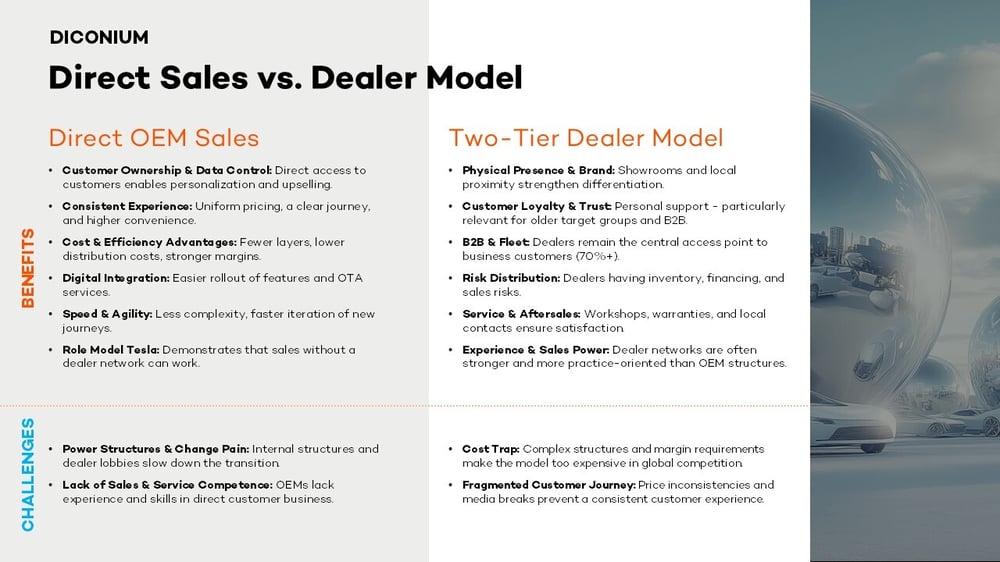
It is well known that these models each have advantages and disadvantages. The crucial question is now a different one: How do OEMs and retail partners become digitally connected - regardless of the setup?
Illustration: D2C vs. indirect sales
The debate is shifting: AI is coming to the fore
The "direct vs. dealer" debate falls short. At its core, it is about a digital business model that secures data sovereignty, improves the customer experience and structurally reduces costs. This is precisely where the next leap in development is taking place with agentic commerce: AI-supported sales/shopping agents that prepare decisions - and gradually also support transactions.
Important for realism: today, agents primarily automate orientation, comparison and advice. The next step will be more transactional parts such as scheduling, offer logic, preliminary financing checks or contract preparation - depending on governance, system integration and the regulatory framework.
In the automotive context, this specifically means
-
Automate comparison: Prices, leasing rates, availability, delivery times, equipment.
-
Specify requirements: Translate requirements into suitable configurations.
-
Scaling advice: consistent recommendations across all touchpoints, around the clock.
-
Relieve processes: fewer queries, fewer manual offers, shorter throughput times.
At the same time, people remain indispensable where retail decisions are really made:
-
Responsibility: goodwill, complaints, special cases, commitment.
-
Trust: Recognizing motives, addressing uncertainty, building relationships.
-
Experience: test drive, handover, service quality, bringing the brand to life.
The competitive advantage does not come from "using AI", but from the proper orchestration of human strength and agent-based systems.
What does this mean for the future?
Forecasts show: The global online car buying market will grow from USD 357 billion in 2024 to USD 795 billion by 2033 (CAGR 9.3%)(researchandmarkets.com). And at funnel level, the leverage becomes tangible: A study reports a lead-to-sale conversion of 26% for an AI-enabled retail setup - as a comparison, an average conversion of under 6% in automotive retail is cited(infosys.com).
In our view, four priorities are crucial
-
Data & Consent: clear rights, clear use, clear responsibilities (OEM/retail).
-
Pricing & Offer Governance: uniform rules across all channels, controlled promotions.
-
Retail enablement: tools, roles and processes for end-to-end digital journeys.
-
Agentic readiness: machine-readable product data, integrated systems, measurable automation in the lead process.
Reality is shifting: AI agents are shaping the entry point into the journey; humans are taking over where trust, experience and commitment count.
For a deep dive, contact our experts.
Matthias Rüdiger
senior manager / expert automotive

Thorsten Gramlich
partner & mobility expert



.png?width=327&height=160&name=jsqcd.bf%2c%20(1).png)