Multi-Agent AI in the Tech industry: Foundations, use cases & enterprise strategy with Salesforce
Enterprises in the tech industry are rapidly adopting AI to automate tasks, enhance responsiveness, and scale operations. Multi-agent systems, where specialized agents collaborate, act, and reason, represent the next frontier. Salesforce's Agentforce is emerging as a pivotal platform, enabling tech firms to build these agentic workflows natively within their CRM, customer service, and operations stack. This article delves into multi-agent AI, its real-world applications within the tech and Salesforce domains, and a strategic approach for enterprise adoption.
Why a single AI system isn’t enough
Traditional AI assistants, while capable, often operate as single entities. They can retrieve data or trigger actions, but they struggle when multiple enterprise systems, complex workflows, and intricate business rules are involved.
Agentforce handles what happens inside Salesforce with precision. But when decisions span multiple business systems, it reaches its limits. Enterprises need AI that can bridge these boundaries orchestrating context, logic and action across diverse platforms.
"Imagine a customer messages: 'I was charged twice on my last order.' A naive AI might respond with a canned apology or refund request. But behind the scenes you need: pulling order data, verifying discrepancies in ERP (SAP), checking billing policies, performing the refund, and notifying the customer---across multiple systems. One AI agent, no matter how smart, may struggle to handle all of that reliably, especially in edge cases or failure scenarios."
How Multi-Agent AI works
Multi-agent systems are inspired by how people work in teams. Instead of one monolithic “super-agent,” multiple specialized agents collaborate to reach a goal.
Each agent has a clear role:
- A data agent retrieves and validates information.
- A logic agent interprets business rules.
- An execution agent triggers the right workflows and responses.
Together, they form a distributed network of intelligence one that is more resilient, explainable, and scalable. Rather than replacing human reasoning, multi-agent AI amplifies it, enabling organizations to automate complexity while keeping decisions transparent and traceable.
|
Framework / Layer |
Key Strengths & Offerings |
If Omitted (Consequences) |
|
Salesforce Agentforce |
• Deep CRM Integration (native Salesforce data access) |
• Data silos, no trusted CRM access |
|
LangGraph |
• Stateful orchestration with retries & branching |
• Brittle, hard-coded workflows |
|
AutoGen |
• Dynamic, multi-agent collaboration |
• Simple automation only |
Although Salesforce Agentforce is a powerful and trusted way, to bring AI into CRM processes, its scope is naturally centered around Salesforce itself. When enterprises need AI to reason beyond CRM for instance, pulling data from SAP, coordinating actions across logistics systems, or orchestrating multi-step business logic across APIs a single platform reaches its limits. Designing enterprise-grade AI means thinking beyond one ecosystem, ensuring that intelligence can flow seamlessly between diverse business applications.
That’s why at Diconium, we design AI architectures around a simple principle: no single framework can cover every enterprise need. Salesforce Agentforce, LangGraph, and Microsoft AutoGen each bring unique strengths and together, they form a complete foundation for enterprise-grade intelligence.
A unified enterprise architecture
When combined, these frameworks form a cohesive AI fabric that is both intelligent and governable:
- Agentforce protects and manages enterprise data.
- LangGraph structures how logic and processes unfold.
- AutoGen enables adaptive collaboration between agents.
The result is a secure, explainable, and flexible AI ecosystem one that operates seamlessly across Salesforce, SAP, and other enterprise systems.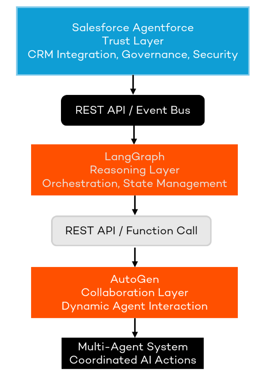
Check out our "Agentforce & Salesforce AI" Discovery Workshop.
A real example: Resolving an invoice dispute
Let’s bring this to life with a common use case in customer service.
A VIP customer reports:
"I see I was charged for expedited shipping, but I didn't select it. Please correct it and refund me."
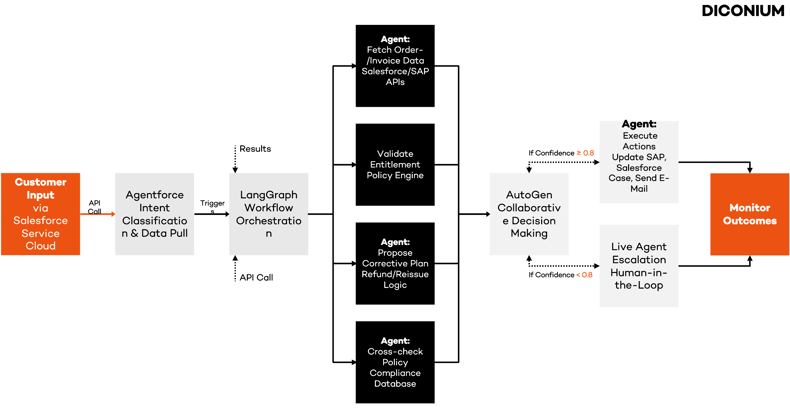
Here’s how a multi-agent system powered by Diconium’s architecture would handle it:
- Understanding the request – The intent is classified as a refund/dispute.
- Gathering data – Order details are retrieved from Salesforce and verified in SAP.
- Applying rules – The system checks refund policies and customer eligibility.
- Reasoning and planning – A corrective plan is proposed (refund, updated invoice, apology email).
- Execution – Updates are made in SAP and Salesforce; the customer is notified.
- Validation – If AI confidence drops below a threshold, it escalates to a human reviewer.
Each framework plays a distinct role in the process: Agentforce ensures secure CRM data access, LangGraph manages orchestration and dependencies, and AutoGen coordinates agent discussions while validating the results, together creating a trustworthy and efficient workflow that automates what can be automated while keeping humans in control.
This detailed architectural flow outlines the multi-agent process for resolving an invoice dispute, showcasing the distinct yet integrated roles of Agentforce, LangGraph, and AutoGen. It highlights key API calls, the flow of information, and the critical human-in-the-loop mechanism for scenarios where AI confidence is below a predefined threshold (e.g., 0.6), ensuring oversight and reliability.
How Diconium builds enterprise-ready AI
At Diconium, our strategy goes beyond the limits of individual tools. We advocate for a synergistic approach, combining the strengths of each framework to forge a robust, scalable, and inherently trustworthy AI system. This hybrid model is instrumental in developing solutions that are not only powerful but also transparent, governable, and aligned with enterprise-grade requirements.
|
Value |
What It Means for You |
|
Trusted by Design |
Every AI interaction stays inside a secure, governed boundary. |
|
Composable by Nature |
Mix and match frameworks Salesforce, LangGraph, Autogen to fit your business. |
|
Scalable in Practice |
From prototype to production without losing visibility or control. |
|
Human in the Loop |
Every AI decision remains reviewable, transparent, and explainable. |
|
Future-Ready |
Modular, adaptable architecture ready for next-generation AI models. |
With this approach, Diconium helps enterprises unlock AI’s full potential responsibly, transparently, and at scale.
Where AI Is heading next
Enterprise AI is evolving fast. The winners of this next wave won’t be those who rely on one system, but those who can combine trusted, open, and adaptive frameworks into a single, orchestrated ecosystem.
At Diconium, we’re guiding that evolution - helping organizations:
- Innovate faster while maintaining compliance
- Build explainable and auditable AI systems
- Empower teams to collaborate effectively with AI
The future of intelligent enterprises isn’t a single agent-it’s a network of intelligent collaborators, working together securely and transparently, and fostering a new paradigm of human-AI partnership.
"Multi-agent AI is not about replacing people. It's about multiplying intelligence- securely, transparently, and at scale."
- Manisha Kumari