Global Delivery
Global Delivery
Achieving the best results with global teams
Global Delivery establishes an integrated operating model in which Client Hubs and technically leading Delivery Hubs work seamlessly together, with clearly defined roles, consistent standards, and global governance.
Your pain points
Not enough speed despite growing teams. Poor integration leads to delays, duplicated efforts, and unclear ownership.
Missing skills for complex products.Specialized expertise in areas such as SDV/Automotive, cybersecurity, cloud/data, embedded engineering, or test automation is often unavailable locally.
Global teams not working as one.
Inconsistent tools, processes, and standards make shared delivery difficult.
Scaling increases complexity.
Without globally aligned governance mechanisms, coordination overhead grows faster than output.
Our solutions
01 Integrated Global Teams
For companies that need speed, end-to-end ownership, and close alignment. One global team with a shared sprint structure, a single codebase, and a synchronized way of working.
02 Strategic Business Unit (SBU)
For long-term, dedicated, and autonomous capacity. Ideal for complex domains with high technical ownership, such as ADAS, compute, cloud, or energy.
03 Standardized shoring setups
For clearly defined, well-scoped tasks such as testing, QA, or repeatable development components. Supported by stable processes, service levels, and high efficiency.
04 Build Operate Transfer (BOT)
For companies looking to build their own international engineering structures. We set up, run, and hand over a high-performing unit, including governance, quality gates, and a KPI framework.
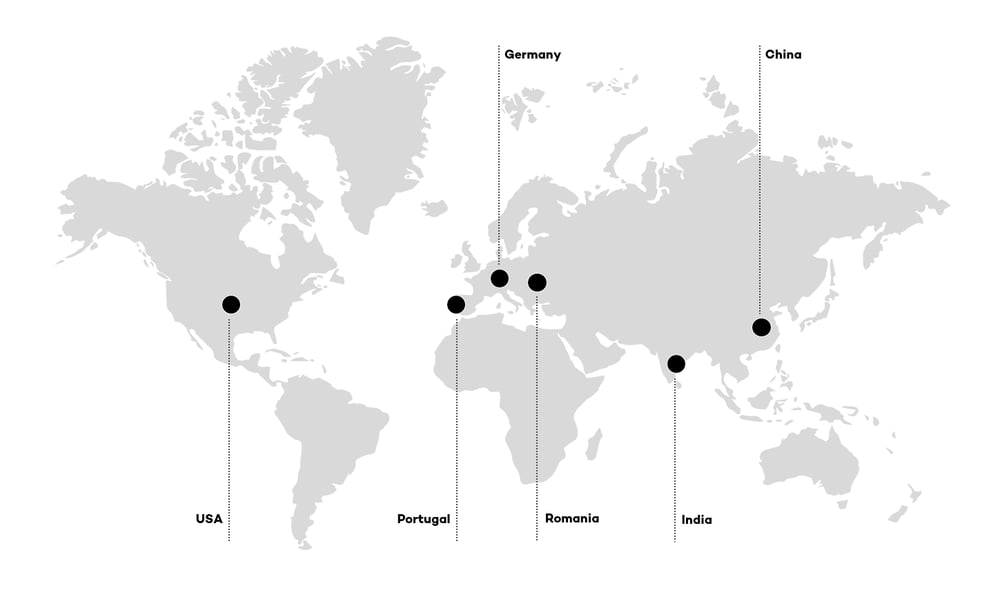
Our Global Delivery locations
Why Global Delivery with Diconium?
Clear role model
Client hubs are responsible for client management and program control. Delivery hubs are responsible for engineering, quality and scalability.
Global governance & KPIs
Consistent governance logic across the entire process, from lead to order through delivery to cash, with clear quality gates, decision paths, and KPI structures.
Best-country fit
Teams are assembled based on competency profiles, maturity, time zone compatibility, security requirements, and availability, not simply by location.
Technical depth
Teams are assembled based on competency profiles, maturity, time zone compatibility, security requirements, and availability, not simply by location.
Proven global teams
Cross-site structures, including teams in Portugal, Romania, and India, enable fast scaling and operational stability.
Success Stories
Since its founding, Embitel Technologies India Pvt. Ltd. has been dedicated to driving digital transformation through advanced technologies in automotive, Internet of Things, connected car, and digital solutions.
- Founded in 2006 as a wholly owned subsidiary of Diconium.
- Broad and deep technical expertise.
- Enterprise-grade security and quality standards.
For Häfele, we built a digital competency center in Porto, Portugal, in record time. Building on our existing infrastructure, local expertise, and strong employer brand, we were able to onboard highly qualified professionals from content management and e-commerce within just a few weeks, fully embedded in Häfele's own teams.
Find your perfect setup
We'll work through it together:
-
Roles, responsibilities and governance
-
Bottlenecks in speed, quality and collaboration
-
Skill requirements and maturity level
-
The right model or combination of models
-
A low-risk pilot and transformation path
FAQ
What sets Global Delivery apart from traditional offshoring?
Offshoring relocates tasks. Global Delivery integrates teams, roles, and processes into a shared system.
What are the roles of Client Hubs and Delivery Hubs?
Client Hubs manage client success and programs. Delivery Hubs ensure technical execution and quality.
Which technical domains does Diconium cover?
SDV/Automotive, cybersecurity, cloud/data, embedded engineering, and test automation.
How does best country fit work?
SDV/Automotive, cybersecurity, cloud/data, embedded engineering, and test automation.
What are the benefits of a BOT model?
It enables the structured setup, operation, and handover of international engineering structures, including governance and quality gates.
