From Risk to Responsibility: ISO 42001 as the Foundation for Effective AI Governance
As the use of AI increases, so do the requirements for accountability, traceability, and risk management. ISO 42001 provides a framework for an auditable AI management system (AIMS) that enables the management of AI throughout its entire lifecycle and facilitates continuous improvement. This article explains which organizational challenges are central to this process and how the PDCA cycle enables sustainable governance.
The gradual spread of invisible risks
The public debate on AI risks focuses primarily on technical risk dimensions—algorithmic biases, limited explainability, and data protection issues. These dimensions are undeniably relevant, but they capture only a fraction of the actual scope of risk.
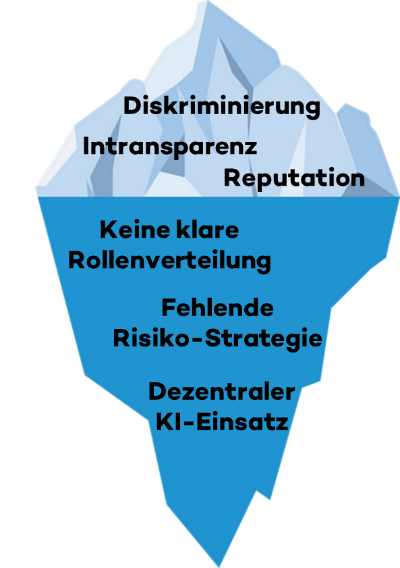
According to a cross-industry survey of companies operating in the EU, 71% of respondents rate their AI risk governance as “less than mature”; fewer than 10% already fully comply with the requirements of the EU AI Act (see McKinsey & Company, 2024). The quantitatively and qualitatively more significant part of the risk landscape thus remains in the organizational realm: structural vulnerabilities that do not generate system error messages but nonetheless determine the success or failure of AI initiatives. Unlike technical risks ,organizational and strategic risks are invisible. They do not generate immediate error messages, model drift, or even a red warning in the monitoring system. As long as “nothing happens,” the organization appears capable of functioning, even though key control mechanisms are missing:
- Governance gaps (missing guidelines, no clear AI roles),
- Unclear responsibilities (who approves AI systems?),
- Lack of a data strategy (insufficient data quality, lack of data controls)
- and inadequate change management (training, AI culture).
Such problems often only become apparent once AI systems are already up and running or after an incident occurs. For example, unclear approval procedures or a lack of defined roles (such as an AI officer or governance lead) are hidden vulnerabilities that can lead to reputational damage and high remediation costs.
In a typical scenario, so-called “shadow AI” arises when employees use AI applications without formal approval and outside of established control processes. A well-known example is a documented incident at Deloitte Australia: There, generative AI generated false sources and citations because the AI system was running “uncontrolled,” resulting in significant reputational damage. This case exemplifies how the absence of binding usage guidelines and control mechanisms gives rise to substantial liability and reputational risks. (See The Guardian, 2024).
Without comprehensive AI governance, compliance violations, security vulnerabilities, and liability risks arise. Furthermore, since its entry into force, the EU AI Act has established mandatory requirements—including the implementation of a risk management system and qualification-based training requirements for staff—and failure to comply is subject to significant penalties. Without a functional AI governance framework, it is virtually impossible to meet the challenges mentioned above or fulfill the legally mandated obligations.
While “traditional” technical risks are already systematically addressed in many companies, organizational risk aspects are often overlooked. The following table highlights these differences.
|
Visible AI Risks |
Invisible (Organizational) Risks |
|
Algorithm bias (bias, fairness issues) |
Lack of AI accountability (unclear roles/responsibilities) |
|
“Black box” (lack of explainability) |
No formal AI guidelines and processes (lack of documentation/audits) |
|
Data protection and security incidents |
Inadequate risk management (no regular AI risk analyses) |
|
Ethical conflicts (discrimination, traceability) |
Lack of training and expertise (lack of continuing education for AI decision-makers) |
|
Legal and reputational issues (fines, loss of trust) |
Uncontrolled AI use (shadow AI and no centralized monitoring) |
ISO 42001 as a Framework for AI Governance
In an era of steadily growing AI use in day-to-day operations and increasing regulatory requirements, it can be difficult for companies to establish a functional governance system or to further develop an existing one in a way that reliably addresses AI-specific risks and responsibilities.
This is precisely where ISO 42001 comes in: For the first time, it offers an internationally recognized framework for an auditable management system designed to manage AI responsibly—not just “technically,” but also organizationally.
ISO standards are voluntary, international standards developed by the International Organization for Standardization (ISO), an independent, non-governmental organization and the world’s largest developer of voluntary international standards.
ISO 42001 is the world’s first management system standard specifically for artificial intelligence. It defines requirements and provides guidance for establishing, implementing, maintaining, and continuously improving an Artificial Intelligence Management System (AIMS) within organizations. The AIMS is neither a single tool nor an “AI department.” Rather, it is a structured framework consisting of interconnected and interacting elements, such as AI-specific policies and objectives, processes for risk and impact assessment, and monitoring mechanisms. It links strategy, accountability, and risk management with evidence-based decision-making and continuous improvement. In this way, AI systems can be developed and deployed responsibly. Additionally, this enables the ethical, transparent, and verifiable use of AI systems. A certified AIMS signals to customers, partners, and regulatory authorities that the company is actively managing AI risks. Thus, an AIMS reduces costly decision-making errors and reputational risks and builds trust.
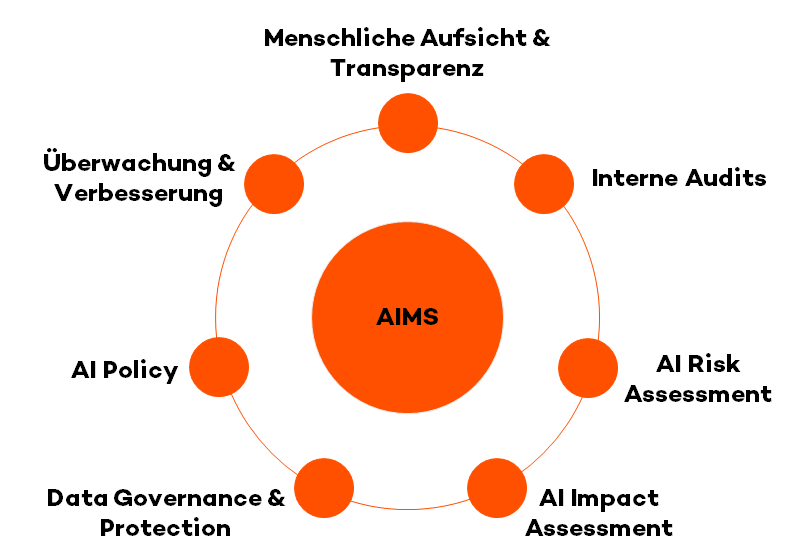
The standard is intended for organizations of all sizes that develop, provide, or use AI-based products or services.
PDCA Cycle for an AI Management System
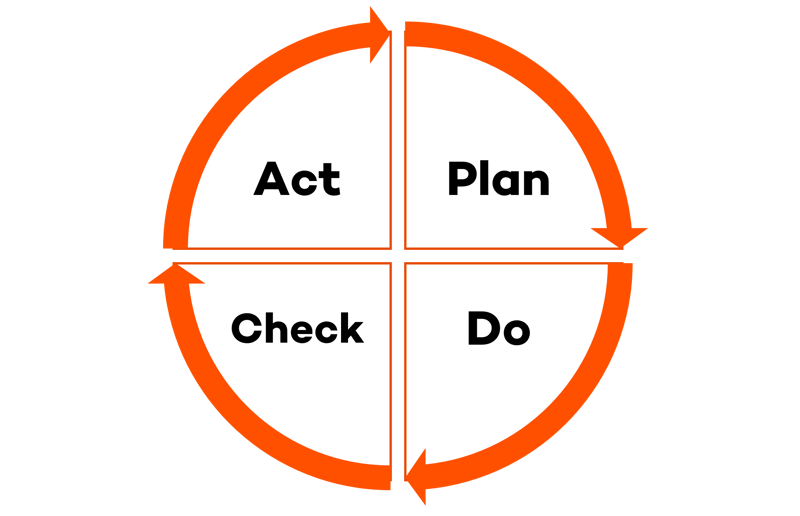
Like other ISO management system standards, ISO 42001 also uses the proven Plan-Do-Check-Act (PDCA) cycle. This four-step improvement process is established in numerous ISO standards (e.g., ISO 27001, ISO 9001) and facilitates the systematic implementation and optimization of an AI management system.
This approach is particularly relevant for AI governance, as risks and requirements related to AI are not static. AI systems are constantly evolving due to new data, changing usage contexts, or technological advancements. AI governance therefore cannot be viewed as a one-time measure but must be established as an ongoing control process.
The need for adaptive AI governance is currently particularly evident in the use of agentic AI. Autonomous systems that plan and act independently lead to new risk profiles and more complex decision-making chains, making continuous monitoring and clear lines of responsibility essential. AI governance must therefore be understood as an ongoing process that evolves alongside the maturity and autonomy of the systems.
ISO 42001 applies this principle to the responsible use of AI, thereby creating a structured framework for systematically addressing organizational risks. The added value lies particularly in conceiving governance not as an isolated compliance measure, but as an integrated management process that is embedded across the organization.
The PDCA approach allows for a structured approach to addressing invisible and organizational risks (such as a lack of guidelines, unclear roles, and incomplete processes): Each phase of this cycle specifies how governance requirements are established, implemented, reviewed, and improved.
Conclusion and Recommendations for Action
ISO 42001 currently provides the only internationally recognized certification framework for an auditable AIMS, thereby establishing the structural foundation for managing AI not only technically but also organizationally. Regulatory requirements such as the EU AI Act provide a binding framework that organizations must implement in a context-specific manner. Given the significant variations in maturity levels in practice, a structured, phased approach is recommended.
The following recommendations are intended to help organizations systematically assess whether and to what extent ISO 42001 certification is appropriate, what specifically should be certified, and which measures must be addressed with high priority to close governance gaps and mitigate risks.
Analysis of the AI Landscape as a Starting Point
begins with a structured screening of the existing AI landscape. The goal is to conduct a systematic assessment:
- Where are AI systems already in use or planned?
- Which business processes are affected?
- What dependencies exist with regard to data, IT infrastructure, and external providers?
- Where are AI agents—capable of planning or executing tasks autonomously—already in use or under development?
Without this big-picture view, a well-founded risk and requirements assessment is not possible. Experience has shown that this step also identifies previously informal or unauthorized uses that operate outside of formal control structures.
Defining the Scope of the AIMS
The scope of the AIMS must be defined based on the AI landscape. This involves deciding which organizational units, products, services, or processes should be covered by the management system. Furthermore, defining the scope is a strategic decision: a scope that is too broad increases implementation effort and certification costs; a scope that is too narrow, on the other hand, risks excluding significant risk areas and limiting the added value of certification.
Structured Gap Analysis
The next step involves a systematic comparison of the current state with the requirements of ISO 42001. This process assesses the extent to which key governance elements are already in place or are missing. Typical gaps are particularly evident in
- missing or unclear roles and responsibilities,
- undefined decision-making authority for AI systems,
- a lack of guidelines and processes,
- a lack of risk and impact assessments,
- as well as insufficient documentation and record-keeping.
The gap analysis provides the evidence-based foundation for prioritized action planning.
Development of a prioritized roadmap and action plan
Based on the identified gaps, a roadmap is developed that prioritizes actions according to risk, urgency, and feasibility. Fundamental governance issues typically have high priority, such as establishing clear responsibilities, defining decision-making and approval processes, developing a comprehensive AI policy, and ensuring consistent risk management throughout the entire AI lifecycle.
The roadmap serves as a pragmatic framework for gradually establishing auditability without jeopardizing ongoing operations.
Assessing the Benefits of Certification
Only on the basis of this structured preliminary work can a well-founded assessment be made as to whether ISO 42001 certification makes sense for the organization, what added value it provides, and what time and organizational effort can realistically be expected. Regardless of formal certification, simply engaging in a structured examination of scope, governance gaps, and prioritized measures already makes a measurable contribution to risk transparency and the organizational manageability of AI.
From Governance Structure to Operational Implementation
ISO 42001 establishes the organizational framework for an effective AI management system. However, it is crucial to translate the resulting requirements into concrete processes, responsibilities, and technical systems. This is precisely where Diconium’s Legal Engineering comes into play: It bridges the gap between regulatory requirements and a company’s operational reality. In the context of the EU AI Act, for example, this means firmly integrating risk classification, documentation, and traceability into the development and operation of AI systems.

.jpg?width=327&height=160&name=Cover_022%20(10).jpg)